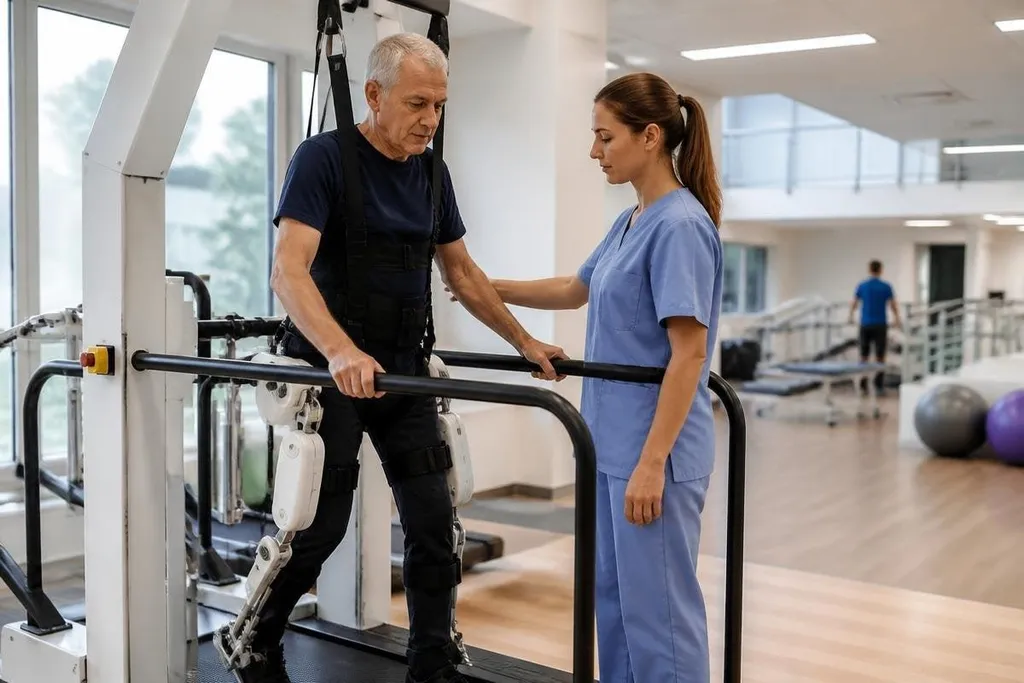
A rehabilitation robot can guide an arm, support a patient’s legs, or repeat a walking exercise. That extra practice may help a person work on movement for longer, but the robot still needs a therapist to choose the task and judge the result.
Quick read
- Repeated movement can give patients more practice during a therapy session.
- Sensors can record motion, force, and task results for review.
- Poor fit, weak setup, and limited judgment can make a robot unsafe or unhelpful.
What these robots do
Rehabilitation robots are machines built to assist physical therapy. Some use an exoskeleton around the legs. Others move a patient’s arm through a guided path or support part of their weight over a treadmill.
The robot follows a set task while sensors measure movement. Those sensors may detect joint position, speed, force, or the point where a person stops moving. That information lets the therapist adjust the task instead of relying only on visual checks.
The machine can also repeat the same motion many times. That matters when a patient needs practice after a stroke, spinal cord injury, or other condition that affects movement. Repetition has a clear use, but the correct motion still depends on the patient and the treatment plan.
Where the benefits appear
A robot can help with tasks that are tiring for a patient or demanding for a therapist to repeat. Weight support, for example, can let a person practice stepping before they can carry their full body weight without help.
The level of support can change during a session. A patient may start with more assistance and take on more of the movement as their control improves. That change must be set and checked by a trained person because a harder task is not always a better task.
Robots can also keep a record of each session. Session records let a therapist compare movement speed, range, or force across visits, then use that record when planning the next exercise.
The record is useful only when the sensors are placed correctly and the same task is repeated in a comparable way.
The record should name the robot, exercise, clinic, and test date before you judge a reported benefit. Robot24.com rehabilitation robotics coverage can point you to reports with those details before the next section weighs risks and limits.
The risks and limits
A robot can apply force to a person’s body, so poor calibration or a bad fit can cause pain, strain, or a fall. The emergency stop, straps, supports, and joint settings need a check before each session.
The machine may also guide a movement that looks correct on a screen but feels wrong to the patient. Pain, fatigue, fear, and small changes in balance are hard for sensors to judge. A therapist can notice those signs and stop or change the task.
Cost and space affect access too. A clinic may need staff training, maintenance, safety checks, and enough room for the equipment. Those needs can make a robot hard to justify when a simpler tool supports the same exercise.
There is also a risk of treating a score as the whole patient. A higher step count or wider joint movement does not, by itself, show that someone can move safely at home. The useful question is whether the practice helps with a real daily task.
A practical check before use
A clinic or care team should ask these questions before choosing a system:
- Set the task: Which movement will the robot support, and what daily activity does it serve?
- Check the patient: Can the person follow instructions, report pain, and tolerate the device?
- Check the fit: Do the supports match the person’s joints, height, weight, and movement range?
- Plan supervision: Who watches each session, and who can stop the robot quickly?
- Read the data: Which measurements will change the therapy plan rather than fill a chart?
- Count the work: Can the clinic cover training, cleaning, repairs, and setup time?
What should happen next
Robots are most useful when they add safe practice to a therapist’s plan. They are a poor substitute for assessment, conversation, and changes made in response to the person in front of the clinician.
I’d choose a rehabilitation robot only when the clinic can name the task, the safety checks, and the decision the collected data will support. The machine should earn its place through better therapy, not through the fact that it has motors.